

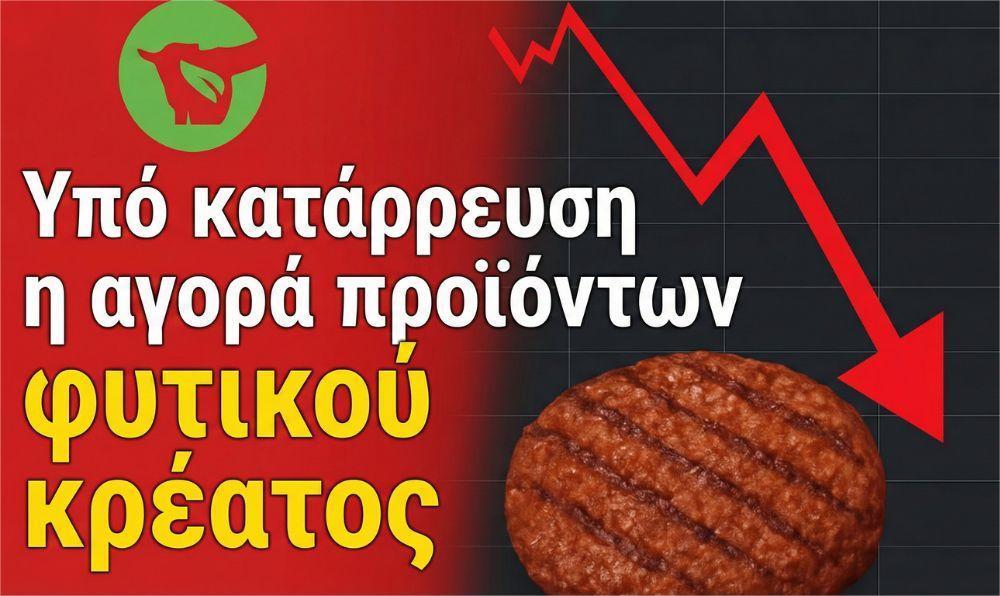
Return to natural meat after the “green frenzy”: Why plant-based products collapsed and what could replace them
Although plant-based substitute technology began developing experimentally in the early 2010s in Silicon Valley labs, the real “boom” occurred in 2019, with the spectacular stock market debut of companies such as Beyond Meat.
Interest continued over the next four years and peaked in 2023, with Wall Street and international stock exchanges orbiting the “Green Frenzy,” as billions of dollars in investment capital flowed into companies promising to replace livestock farming by launching lab-made products with texture and flavor that mimicked animal meat.
The investment wave was, in fact, so sweeping that it pulled in even the market’s traditional “rivals,” with some of the biggest players—such as Tyson Foods and JBS—pouring massive capital into related startups or launching their own lines of such products, fearing they might miss the train of the new era.
Today, the climate of investment euphoria has completely reversed. The valuations of flagship companies in the sector, such as Beyond Meat, have shrunk dramatically, having now lost more than 90% of their value from their all-time highs, while multinational groups like Nestlé are streamlining their portfolios, withdrawing related product lines due to low demand.
Macroeconomic data and consumer trends point to a clear shift: the market is returning to natural meat. What are the underlying factors behind this collapse, and how is the new balance in the food market taking shape?
The three pillars of the decline
Food market analysts attribute the “bubble” to a combination of inflationary pressures and miscalculations regarding consumer behavior.
- Pricing disparity: The primary obstacle proved to be economic. Plant-based products failed to achieve the long-awaited price parity with conventional meat. In an environment of high inflation and squeezed disposable income, their significantly higher cost became prohibitive. The average consumer—especially the crucial mass of “flexitarians”—returned to animal meat (chicken, pork), as it remains the optimal choice in terms of value for money.
- The myth of the healthier option: The core argument that plant-based products were a healthier choice collapsed. Consumers began reading labels and realized the reality: for a plant-based product to achieve the taste and texture of meat, heavy industrial processing is required. Natural meat regained public trust, as it is a natural raw ingredient, unlike substitutes that are loaded with artificial additives.
- Saturation and lack of repeat consumption: The initial sales figures were driven by trial rather than true product loyalty. Consumer curiosity was satisfied; however, the product failed to integrate into everyday dietary routines, leading to a sharp decline in sales volume once the initial promotional phase ended.
Strategic repositioning and product evolution
Companies that are surviving are being forced to change their business models. They are abandoning the obsession with technologically costly meat imitation and shifting toward “clean label” products that highlight plant-based ingredients (legumes, vegetables) without transforming them into something they are not.
The new strategy focuses on the essence of nutrition rather than the marketing of imitation. The goal is to create a distinct category of plant-based foods that no longer seeks to visually or taste-wise “compete” with meat, leaving that role exclusively to animal-based products.

